
Grand Bazaar
Istanbul’s covered market grew around secure trading buildings called bedestens. The transition from these heavy masonry cores to branching lanes of shops explains its varied scale. Look up at the vaults and follow the changes in street width as well as the displays.
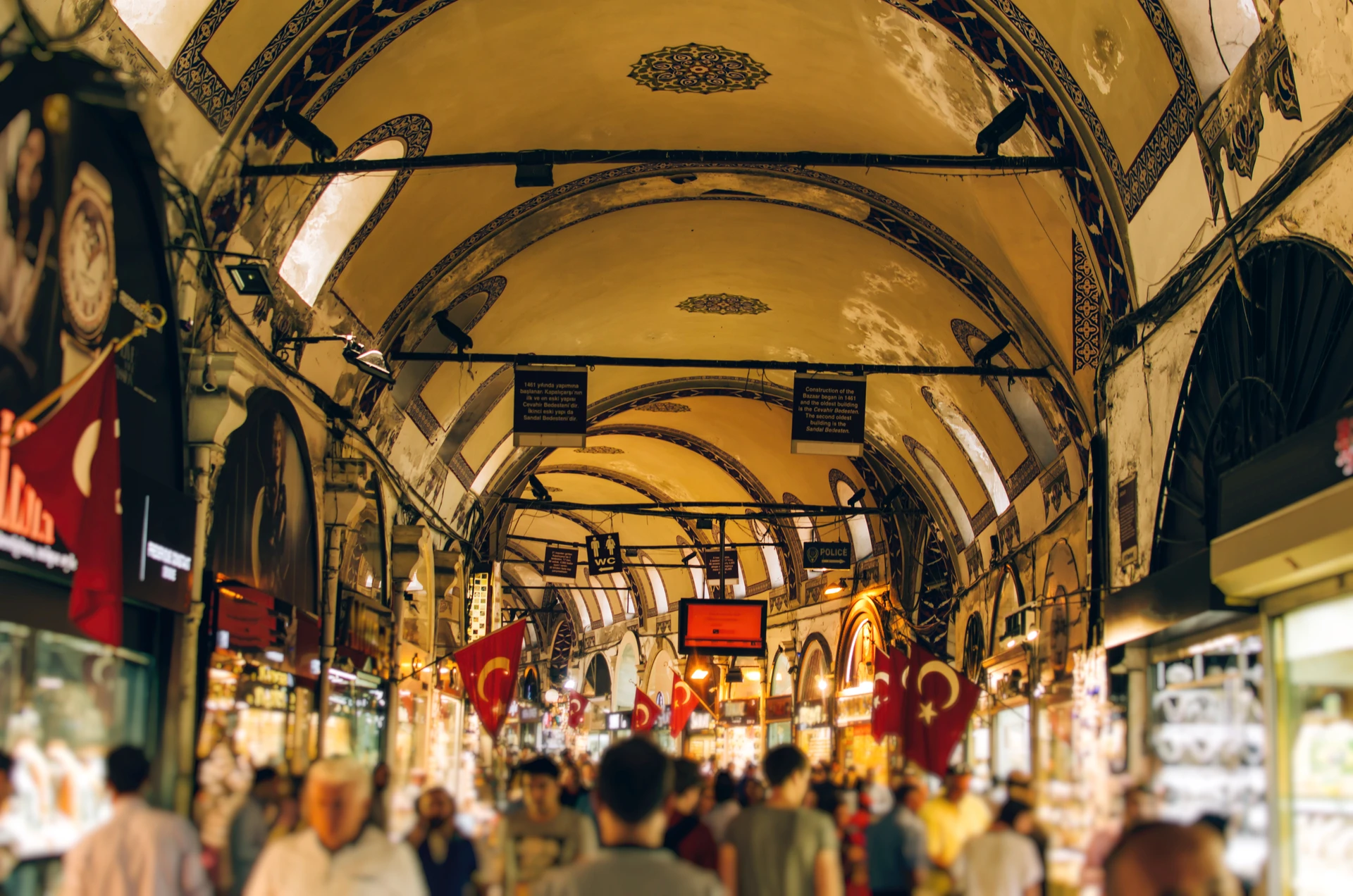
A roof over part of the city
A first visit to the Grand Bazaar can begin with a small surprise. After passing through an entrance, you may feel that you are still outside. The lanes have intersections, addresses, signs and different directions of traffic. There are shop thresholds, places to pause and points where a new street opens unexpectedly to one side. The weather is shut out overhead, but much of the logic of a city street remains. The Turkish name Kapalıçarşı means covered market. It captures the most useful distinction to remember on arrival. This is a district of trade enclosed and roofed over in stages.
The market sits on the historic peninsula between the Beyazıt and Nuruosmaniye areas. Roads from the surrounding quarters feed into its gates, and commercial streets continue beyond them. There is no moment at which all the shops of one kind end and ordinary Istanbul begins. On foot, the transition can be gradual until a gate or a change of roofing makes it unmistakable. Consider the difference between looking for a particular purchase and looking for the form of the place. On one walk you follow displays. On the other you notice the width of a lane, the height of the vault and the way neighbouring trades use their thresholds.
A commercial foundation after the Ottoman conquest
The beginnings of the Ottoman bazaar belong to the rebuilding and repopulation of the city under Mehmed II after 1453. A growing imperial capital needed dependable places to exchange goods, store valuable merchandise and connect producers with buyers. Establishing a protected commercial core also made good sense in a city that linked maritime and overland routes. The merchandise that reached the capital could travel an immense distance, yet the completion of a transaction still depended on storage, personal knowledge and trust between people occupying a comparatively small space.
The covered area expanded over subsequent centuries. Additional buildings and trading streets were connected, and repairs after fires and earthquakes changed its appearance. Its present form is therefore the outcome of many decisions by merchants, administrators, property owners, foundations, repair crews and public authorities. Describing the bazaar as having been built on a single date conceals most of its history. It is more useful to ask what each part was built to do. A secure vaulted hall, a narrow passage lined with shop counters and a large street between major gates offered different advantages to the people who worked there.
The bedestens at the heart of the market
Two buildings are especially important for understanding the development of the bazaar, the İç Bedesten, also called the Cevahir Bedesteni, and the Sandal Bedesteni. A bedesten is a substantial covered trading building associated with the safeguarding and sale of valuable goods. Thick masonry, a limited number of entrances and a roof composed of repeated vaulted or domed units made such a building different from a row of open stalls. Bringing costly goods together under controlled conditions made security a collective concern and gave traders a place in which valuable stock could be kept.
Look at the large supports that divide the interior of a bedesten. The columns or piers are set far enough apart for trading activity, yet close enough to carry the individual roof units. At the scale of the entire building they create a regular plan. At the scale of one person browsing they interrupt views, create corners and give a trader a recognisable place to occupy. If you enter from one direction and leave by another, take a moment to look back at the doorway from the street. The transition between the compact hall and the branching market around it makes the historical importance of these cores much easier to grasp.
The name Sandal can be confusing to English speakers. In this context it is associated with a textile, rather than the leather footwear that the same spelling suggests in English. Trade terms like this survive in the names of buildings and streets long after the range of goods sold there has changed. A name may preserve the memory of a particular material or occupation even where a window now displays something entirely different. Listening for those older terms can turn an apparently bewildering map into a partial record of Istanbul's economic history.
Why related trades gathered together
Historic markets often concentrated particular trades in particular streets. Close neighbours could share information about quality, locate a specialist supplier, direct a client to a colleague, or keep track of expectations within a profession. A buyer looking for a certain kind of work benefited from being able to examine several examples in one area. The Grand Bazaar retains traces of this organisation in street names connected with occupations and goods. Present-day businesses respond to rents, visitor demand and changing methods of production, so the correspondence between an old street name and every modern shop is seldom exact.
Clustering also made specialist knowledge visible. Consider a piece of jewellery undergoing repair. An apparently simple ring may need attention from someone able to set a stone, reshape metal, work on a clasp or restore a surface finish. The shop receiving the customer need not carry out each step itself. Its importance may lie partly in knowing whose hands should do the next piece of work. The finished object seen in a window reveals the outcome of such relationships while displaying very little of the network itself. A question about how an item was made can therefore be more revealing than a question about how old the shop is.
Inns, workshops and the space behind a display
The great commercial quarter was associated with hans, buildings historically used for activities such as storing goods, accommodating merchants or providing space for workshops. Many examples of this type have rooms ranged around a court. A courtyard allowed movement between rooms, helped bring light into the building and supported work that a narrow selling counter could not accommodate. The precise function varied from one building to another and over time. A room associated with one trade in an earlier account may serve an entirely different purpose today.
The distinction between a visible selling street and a quieter working area is particularly interesting for someone trying to understand the production of goods. The shopfront is arranged for a quick judgement about what is on offer. Work behind it may require tools, concentration, continual deliveries or communication between specialists. Some courtyards and passages are working premises or private property. Discovering a door does not imply an invitation to enter. A guide who knows the quarter can help identify appropriate public routes and explain what the less visible parts of the commercial district contributed to the life of the bazaar.
Stone, fire and the experience of enclosure
A market combines valuable stock with a remarkable concentration of people and materials. Fire was a recurrent danger in historic Istanbul. Masonry, substantial doors and vaulting offered protection, although no building material eliminated the risks of fire or earthquake. Repairs following disasters altered the market's footprint and finishes. The severe earthquake of 1894 is one episode in this long history. Looking closely at a passage can reveal differences in the width of an arch, the arrangement of a pier or the treatment of an opening. Such variations are a better introduction to a building assembled over time than the expectation of complete uniformity.
Paint and decoration give continuity to long runs of vaults. Groups of arches draw the eye along a street even when the merchandise on either side changes completely. At an intersection, look straight up before turning. One route may have a higher vault or admit more light, while a side passage feels narrower and more contained. These shifts offer useful bearings. After following displays for several minutes it can be surprisingly difficult to remember whether a turn was to the right or left. The height of a roof or the position of a broad entrance can be easier to recognise than an individual window whose stock has been rearranged.
Looking closely at an object before discussing a price
A woven piece offers a good example of how the visit changes when attention shifts from the quantity of shops to the character of one object. Look at its edge, the reverse if the seller offers to show it, the relationship between pattern and structure and the way the colour changes as it is turned. A flatwoven textile and a knotted pile carpet have different constructions. A decorative motif alone cannot establish where a piece was made, who made it or how old it is. Ask the seller to explain which features support a particular description, and distinguish a documented origin from an attractive account of a design.
A ceramic bowl invites a different set of questions. Is the decoration painted by hand, transferred or applied in some combination? What is the body made of, how does the glaze sit on it, and is the piece intended for display or for use with food? A modern object may draw on the floral vocabulary of Ottoman İznik ceramics while being made by a contemporary workshop elsewhere. It can be appreciated more fully when described accurately. The same principle applies to metalwork, leather and jewellery. Information about the actual maker and technique often gives a purchase far more meaning than a broad claim that something is traditional.
Conversation, comparison and the pace of a purchase
Bargaining is part of the experience in some shops, while others use fixed prices. There is no universal percentage that represents a fair final price for every category of goods. Materials, workmanship and the terms of the sale matter. Two pieces of similar size can differ greatly in quality or labour. A useful first step is to establish exactly which item is under discussion, the currency of the quoted price and what is included. A friendly conversation can be enjoyable in its own right. It does not oblige either person to conclude the sale.
For anything that needs to be sent home, the arrangements are part of the object you are buying. Confirm its description, the address, packing and who is responsible for transport charges in writing before agreeing. For a small item carried away on the day, a receipt and the name of the shop make later enquiries much simpler. These practical details support the same kind of trust that has always been important in a trading district. They also make comparisons fairer. An offer including substantial services and one referring only to the price of the goods describe different transactions.
The streets outside the gates
The quarter around the bazaar adds useful context. Towards Nuruosmaniye, the mosque complex places a major Ottoman religious foundation close to important commercial gates. Towards Beyazıt, book traders and other longstanding businesses form part of a different urban setting. Downhill towards the Golden Horn, further trading streets link the area conceptually to the waterfront through which so much merchandise once passed. The covered market forms a memorable centre within this wider landscape. It cannot by itself explain all the work of making, transporting and selling that sustained the historic peninsula.
It is also easy to confuse the Grand Bazaar with the Spice Bazaar in Eminönü. They occupy different locations and have different histories. The Grand Bazaar is a large network of covered lanes and buildings. The Spice Bazaar has its own architectural setting nearer the waterfront, associated with the New Mosque complex. Both are active commercial places. Placing them on a map before a tour helps to make sense of the slope down towards the water and of the relationship between the port and the trading streets above it. Including one in an itinerary does not automatically mean that the other is part of the same stop.
A route that leaves room to discover something
Agree on a meeting point identified by a particular gate or a clearly named landmark before separating, especially on a shore excursion. From there, combine a broad street, one smaller lane and a look at a bedesten rather than trying to cover the entire market. That combination reveals three scales of trade within a short walk. It also leaves room for an unplanned conversation or a closer inspection of a piece of work. A photograph of the gate name can be a more useful aid to orientation than a photograph of a crowded junction.
On the way out, consider which part of the market you would recognise with the shop displays removed. It might be a shaft of daylight at a turn, the thick supports beneath a cluster of domes, or a slope that led naturally towards a gate. These features have outlasted countless changes in merchandise and ownership. At the same time, it is the call between neighbours, the arrival of a parcel and the handling of goods across a counter that keep this architecture alive. The best memory of the Grand Bazaar usually has room for both the enduring shape of a street and the brief encounter that happened in it.