
Hippodrome of Constantinople
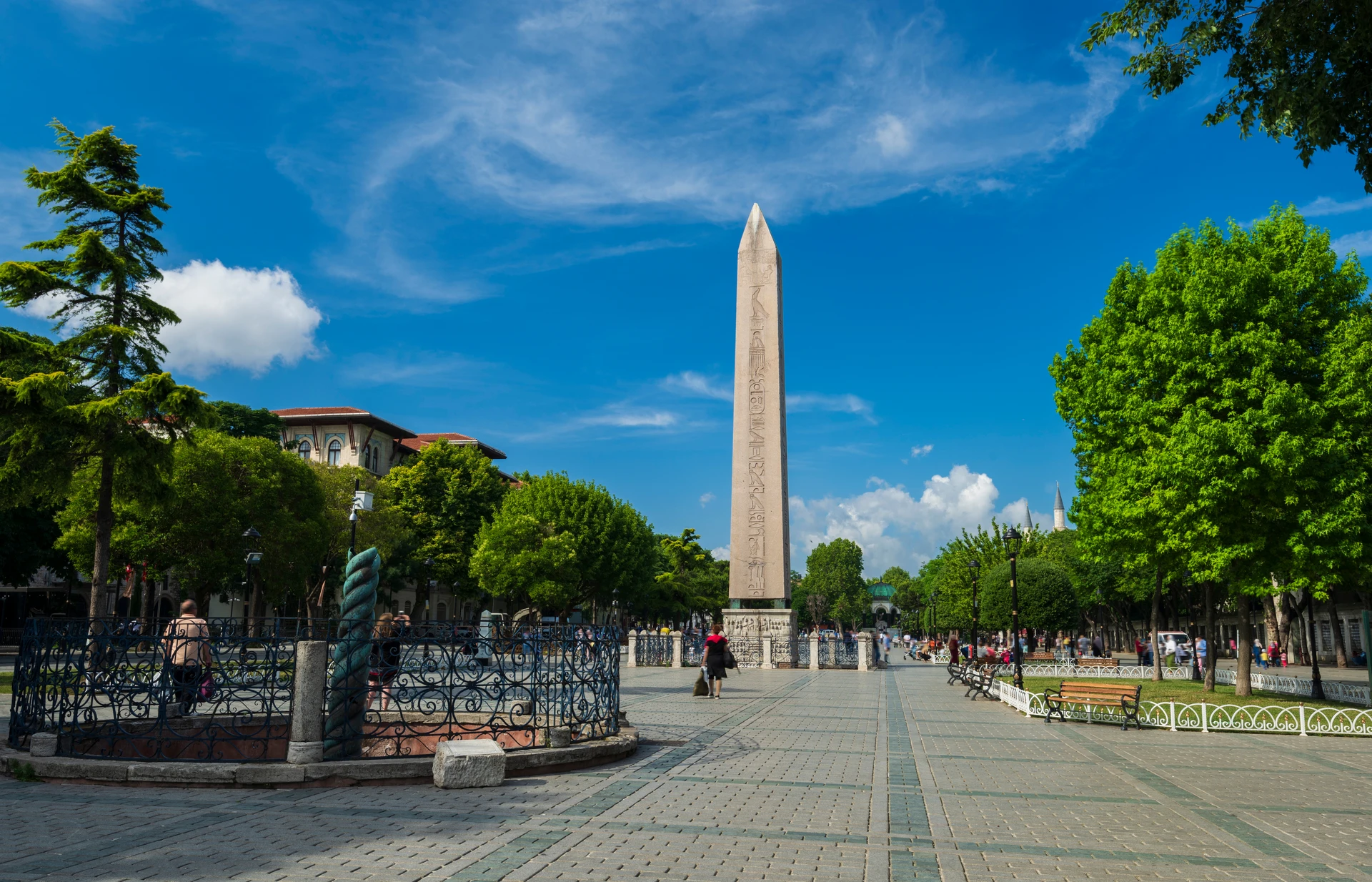
The open square beside the Blue Mosque follows the long axis of the Byzantine racing ground. The Egyptian obelisk, Serpent Column and masonry obelisk once stood along its central barrier. Their alignment makes it possible to imagine the circuit after the seating disappeared.
Finding a racetrack in a public square
Stand at the northern end of the long square beside the Blue Mosque and look towards the row of slender monuments. The large space around them once held the Hippodrome of Constantinople. The monuments occupied the middle of a racing circuit, so people now walk approximately where horses and chariots once ran. The two long sides of the stadium have largely disappeared beneath the surrounding city. Its axis, however, remains unusually clear. Before looking at the individual stones, walk a little way down one side of the line and turn to look back. It takes remarkably little imagination to recover the direction of travel.
The Greek word hippodromos means a course for horses. In the Roman world this type of building served chariot races, public ceremony and the appearance of the ruler before an urban crowd. Comparable buildings existed across the empire, although few had the political importance of the one in Constantinople. A racing ground can seem a surprising neighbour for a palace and a cathedral. In this city the arrangement was purposeful. The emperor, court, clergy and people could occupy different spaces within a short distance of one another. A ceremony could move between those spaces and change its audience without leaving the heart of the capital.
From Byzantion to Constantinople
Work on a hippodrome began under the Roman emperor Septimius Severus, before Byzantion became the imperial capital named for Constantine. Constantine enlarged the city's public centre when he established Constantinople in the fourth century. A hippodrome on a metropolitan scale suited his project. It provided a place in which the population of the expanded city could gather, and where a ruler could be seen distributing honours or presiding over games. Ancient audiences understood the connection between a successful programme of public entertainments and the standing of the person who provided them.
The builders faced a problem that is still visible in the streets around the square. The ridge runs out towards the Sea of Marmara. Extending a long, level track towards the south required supporting construction where the land began to drop. The rounded end of the stadium, called the sphendone, rested on massive substructures. From the level of the square, much of this engineering is hidden. From the streets below its southern end the great curved retaining structure gives a very different impression. A seemingly flat expanse in the historic centre of Istanbul is partly an artificial platform on the side of a hill.
The mechanics of a race
Think of the course as two long runs connected by tight turns. The central barrier kept chariots moving in opposite directions apart. Drivers had to negotiate the turning points while competing for a favourable line. The straight sections gave spectators speed and a view of the field. The bends brought concentration, risk and the possibility of an abrupt reversal in the order. A monument beside the central barrier could be passed several times during a single contest. The statues and columns therefore formed a changing backdrop to a moving spectacle, rather than a collection laid out for quiet inspection.
The spectators' experience varied enormously with their position. Someone along the long side could follow the chariots as they approached and swept past. At an end, the turn and the following acceleration would dominate the view. High seats offered more of the overall course, while those closer to the track gave a stronger impression of the animals and drivers. Modern accounts sometimes offer a single precise number for the crowd. Reconstructions depend on assumptions about the extent of the seating and the space each person occupied. The important fact for a visitor is the immense audience that could assemble within sight of the palace.
The ruler in the crowd's field of vision
The imperial box, known as the kathisma, stood on the palace side of the Hippodrome. Access from the imperial complex allowed the ruler to appear before spectators while remaining separate from the entrances and circulation of ordinary attendees. The arrangement made power highly visible. An emperor listening to the crowd occupied a recognisable position. Collective applause, formal acclamations or complaints could be directed at one individual even in a gathering of thousands. The architecture brought ruler and subjects together while maintaining a careful distinction between their places.
The racing factions, especially the Blues and Greens, lent continuity and organisation to the public world of the Hippodrome. Colours identified competitors and generated powerful loyalties. These groups also took part in the ceremonial life of the city. Treating the colours as permanent modern political parties or as simple labels for religious belief leads to misleading conclusions. Alliances and circumstances changed. The episode most often remembered is the Nika uprising of 532, under Justinian, when unrest spread from the setting of the games into a crisis that threatened the emperor. The bloody suppression of the uprising left the Hippodrome associated with imperial vulnerability as well as spectacle.
The obelisk that travelled from Egypt
The pink granite shaft often called the Obelisk of Theodosius began its life in a pharaonic setting at Karnak in Egypt. Its hieroglyphic inscriptions belong to the reign of Thutmose III, long before Constantinople existed. The surviving portion was erected in the Hippodrome under Theodosius I in the late fourth century. Two very different acts of patronage are visible in a single structure. A pharaoh commissioned a monument whose material, shape and writing spoke to an Egyptian audience. A Roman emperor made the transported stone part of the ceremonial centre of a much later capital.
Take a moment to distinguish the granite shaft from its carved marble pedestal. The hard, warm-coloured surface above carries vertical lines of signs. The lighter stone below carries figures arranged in horizontal scenes. Each uses its own visual language to represent authority. The shaft appears very slender from a distance, but the width of its base makes the difficulties of moving it much easier to appreciate. Transport on a ship was only one part of the problem. The stone had to be brought through the city, raised without breaking and settled accurately onto its supports. Success made an engineering achievement into a lasting political image.
The people carved below the stone
The reliefs of the pedestal are a particularly rewarding stop because they give the empty square back some of its inhabitants. Look for the seated or standing ruler framed by the imperial box, surrounded by attendants. Elsewhere are spectators, performers and scenes associated with the games and the erection of the monument. The sculptors arranged figures by rank and by role. Faces in a row can look similar, while the emperor occupies a privileged space that makes him easy to identify. Differences of size or placement help tell the viewer whose action matters most.
Walk around the enclosure if space permits. Reading all the sides from one position is impossible. A scene that looks like a horizontal band from a distance becomes an assembly of people when seen more closely. Notice where a gesture directs attention, how the architecture of the imperial box frames the principal group, and how the lower registers differ from the ones above them. Greek and Latin inscriptions on the pedestal also place the monument in the multilingual world of a late Roman capital. The work pays tribute to the emperor who set up the shaft while recording a specific feat accomplished by people working beneath it.
Bronze serpents from a Greek sanctuary
Nearby, the Serpent Column is smaller and easier to overlook. Its twisting bronze once formed part of a dedication at Delphi commemorating the Greek victory over the Persians at Plataea in 479 BCE. Three serpents intertwined to make the shaft, their heads originally supporting a vessel above. The monument eventually came to Constantinople and became one of the most remarkable objects on the central barrier. Its material, origin and first purpose differ entirely from those of the Egyptian obelisk. Bringing them together made the Hippodrome a place where separate histories could be claimed for a new capital.
The missing heads make the column harder to interpret than a complete ancient sculpture. Follow one ridge around the shaft with your eyes. What first looks like a continuous spiral is the entwining of separate bodies. The lower part of the column sits below the present paving, a useful clue to the changes in ground level. Where the tips and vessel once drew the eye upwards, modern visitors often find themselves looking down into the enclosure. That reversal says something about the preservation of ancient cities. A celebrated monument may survive for centuries through repeated changes of meaning, elevation and surroundings.
A second obelisk with a different construction
Farther along the former barrier stands a second tall monument often called the Walled Obelisk. The contrast with the Egyptian stone is visible without reading a label. Individual courses of masonry break up the surface. The builders created the monumental form by stacking blocks rather than by cutting a single shaft. The monument is associated with restoration under Constantine VII in the tenth century. It once carried a metal facing, now gone. What looks rough and deliberately austere today consequently gives only a partial impression of its earlier appearance.
Stand where the two obelisks can be seen in the same view and compare the qualities that survive. Both draw the eye along the axis of the stadium and both taper upwards, yet their surfaces tell quite different stories. One carries inscriptions intended to be read in ancient Egypt. The other exposes the structure that once supported a finish. One was moved over an extraordinary distance, the other reflects building and embellishment in Constantinople. After this comparison the centre of the track becomes more than a line of decorative objects. It becomes a record of how successive rulers added to an inherited public setting.
The long life of the Horse Square
The Ottoman name Atmeydanı, meaning Horse Square, preserved a link with the earlier use of the ground. The open space continued to accommodate festivities and public gatherings. Ottoman court celebrations could occupy the square for extended periods, with processions, displays and the appearance of organised trades. Illustrations of such events show the square in use centuries after the ancient races had ended. The place remained valuable because it could hold an audience in a densely built part of the city. Buildings defining its sides changed, while the possibility of gathering in the middle endured.
On the western side the palace associated with İbrahim Pasha, today home to the Museum of Turkish and Islamic Arts, recalls the position of powerful Ottoman households around the square. Opposite, the monumental mosque of Sultan Ahmed transformed the eastern skyline in the early seventeenth century. From a single position it is possible to look past a monument brought from an ancient Greek sanctuary towards the courtyard and minarets of an Ottoman mosque. The sequence reflects repeated decisions about an unusually valuable piece of ground. Istanbul's builders repeatedly worked around the inherited shape of the old racing venue.
Reading the present square
At the northern end the domed German Fountain introduces another era of public ceremony and international relations. Its scale and colour make it easy to distinguish from the three surviving monuments of the ancient barrier. Beyond it, the streets lead into a much busier part of Sultanahmet. Between the fountain and the southern end, people still use the central axis as a natural route across the neighbourhood. Others sit at the edges or pause to meet a guide. These ordinary movements help explain why the old track remains perceptible even to someone who comes upon it by chance.
On a two-port itinerary, this square offers an especially revealing comparison with Ephesus. At Ephesus, the theatre still gives a powerful impression of seats arranged around an audience space. In Istanbul the rows of seats are largely absent, but the relationship between a public spectacle and the imperial centre can be traced in the surrounding city. Look once more at the people carved on the base of Theodosius's obelisk, then turn towards the area where the emperor's box stood. A small scene cut in stone supplies an audience, a ruler and a distant palace for a space that at first seemed almost empty.
If you have time for one last change of viewpoint, compare the height of the modern pavement around the Serpent Column with the ground visible at its base. The distance between them gives physical scale to a process that a list of dates can scarcely convey. Generations of inhabitants repaired and resurfaced the square around a bronze object already ancient when it arrived. The visitor now stands on the accumulated result of their work.