
Temple of Artemis
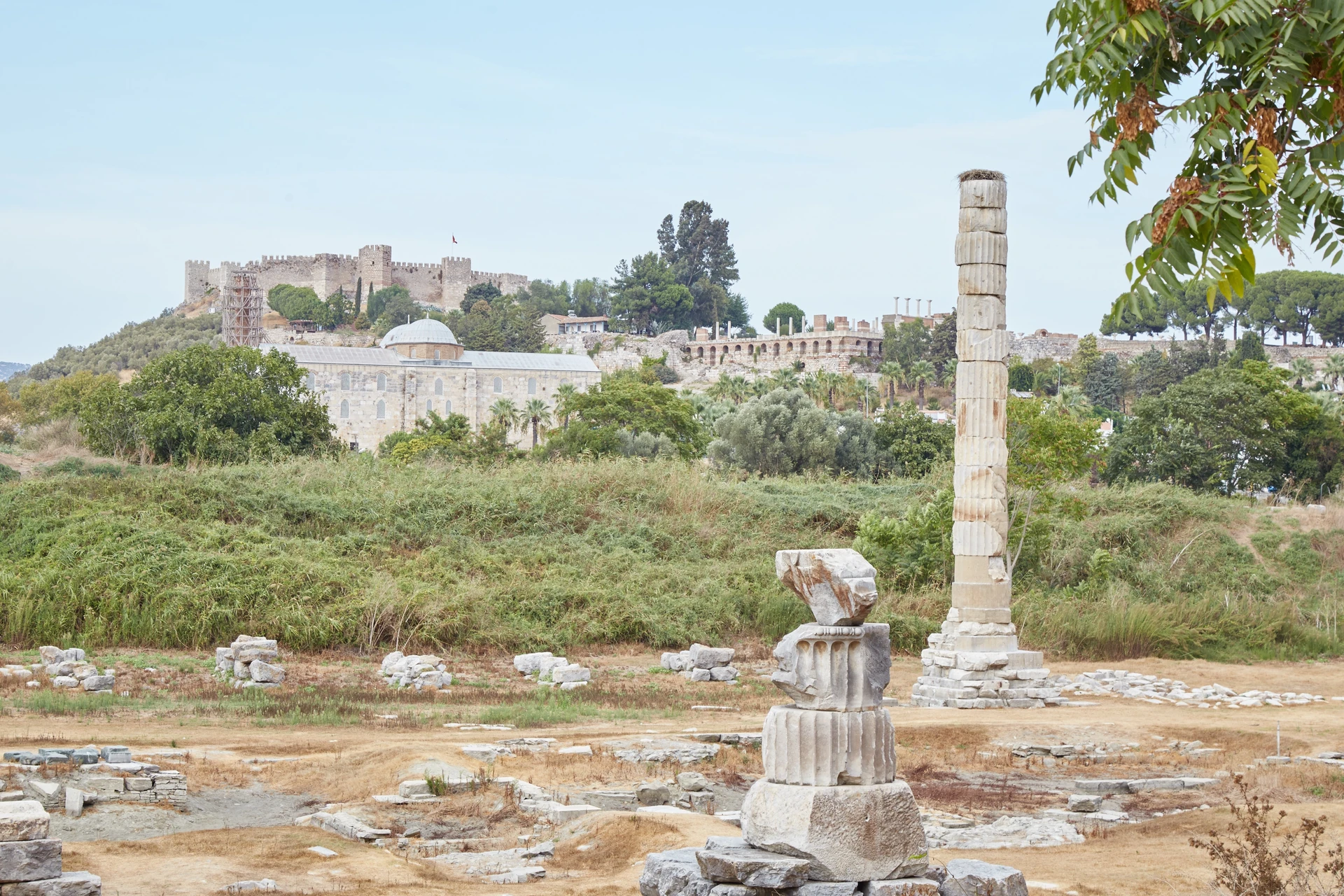
At the Artemision near Selçuk, an isolated reconstructed column marks the scale of the sanctuary. The temple stood outside the later Roman city. Its setting on low ground helps explain why the famous building and the remains visible today look so different.
Why a single column is worth the stop
The Temple of Artemis stood on low ground near Selçuk. From the edge of the site, an isolated reconstructed column rises out of a landscape of scattered stone, vegetation and, at times, standing water. The contrast between that view and the temple's reputation as one of the Seven Wonders of the Ancient World is unusually strong. It changes the way to approach the visit. Instead of scanning for a surviving façade, look at the distance across the sanctuary, the level of the ground and the hills that enclose it. These are the starting points for understanding both why people built here and why the remains were eventually so difficult to find.
The Greek word Artemision means a sanctuary of Artemis. A sanctuary could contain much more than a temple. It might include an altar, routes for worshippers, spaces for offerings, boundary markers and structures used in ceremonies or administration. The temple was its most celebrated building. Religious activity also took place outside its walls, where larger numbers could gather and where people could approach without entering the space reserved for the cult image. The low ground in front of you therefore represents a setting for movement and collective activity as well as the footprint of an enormous structure. That distinction makes the site easier to imagine whatever the water level on the day.
Artemis as the Ephesians knew her
Artemis appears across the Greek world, often as a goddess connected with wild animals and the hunt. The Ephesian cult developed its own striking visual identity. Familiar representations of Artemis of Ephesus show a frontal figure whose body is covered in closely organised ornaments, including animals. The image stands relatively still and presents a richly worked surface to the viewer. Ephesus used this distinctive form to express a relationship between a widely recognised deity and a particular community. Someone who knew the name Artemis from another city might still recognise that an Ephesian image belonged to this sanctuary and this place.
The Ephesus Archaeological Museum in Selçuk provides an opportunity to examine important surviving examples of that image type. It is useful to keep a statue's findspot separate from its subject. A sculpture of Artemis recovered from a public building in the ancient city can tell us about the goddess's presence in civic life without being the original cult statue from the temple. Images could also appear on coins or small objects that travelled far beyond the sanctuary. A visitor who has seen the museum can bring the figure mentally into the architectural setting. Someone going there afterwards can do the reverse and consider how such a recognisable image acquired meaning beyond the confines of a gallery.
A sanctuary older than the famous building
Religious activity at the Artemision preceded the enormous marble temples for which Ephesus became famous. Excavations have revealed earlier structures and offerings beneath later construction. Working down through those levels is different from walking from one standing building to another. A small votive object from an early phase may survive because it was buried below a later floor. A much grander building from a later period may leave surprisingly little because people took away its exposed stone. The amount visible today is a poor measure of the importance of any one phase when it was in use.
The decision to enlarge a sanctuary often involved a tension between inherited place and architectural ambition. A community might want a much greater building while retaining a sacred focus whose location mattered. New foundations, columns and formal approaches had to accommodate that relationship. At Ephesus, the recurrent investment in this particular stretch of low ground becomes more understandable if we take the history of worship seriously. From the viewpoint of uncommitted builders, many alternative sites might have offered advantages. From the viewpoint of people making a dedication to Artemis of Ephesus, the continuing identity of the sanctuary was part of what gave the new work its value.
Marble and the intervention of a king
In the sixth century BC, an immense marble temple took shape here. Croesus, the king of Lydia, was an important benefactor. The connection survives in ancient testimony and in fragments of an inscription connected with his dedication. Greek-speaking cities on the Aegean coast had close and sometimes difficult relations with powerful rulers inland. Contributing to a sanctuary could express piety, wealth, prestige and political relationships at the same time. A worshipper passing a column associated with a royal gift encountered something more than the generosity of an individual. The building made that relationship visible in the shared religious landscape of the city.
Funding marble construction meant paying for work that the finished surface usually concealed. Stone had to be identified, quarried, moved to the site, cut to shape, lifted, aligned and finished. A column made from stacked drums required precise contact between successive pieces. Small errors low in the shaft could affect the alignment far above. Fluting carried a continuous visual rhythm up the column and made a change in orientation conspicuous. Skilled workers had to coordinate what happened on the ground with what would be visible after assembly. Standing where only one reconstructed shaft breaks the skyline, imagine that chain of labour repeated across an entire forest of supports.
Walking around an Ionic temple
The Artemision is an outstanding example of the monumental Ionic tradition of the eastern Aegean. An Ionic capital is familiar from its paired scrolls, but the order involved much more than an ornament at the top of a shaft. The bases, proportions, spacing and relationship between columns and the building they enclosed organised the whole experience. The great Ephesian temples had double ranks of columns around the central structure. A person approaching could have seen some columns lined up and others opening into diagonal views. A slight change of position would alter which shafts overlapped and how much of the wall beyond could be seen.
This repeated rhythm matters when looking at illustrations. A reconstruction drawn straight on often resembles a screen with a set number of upright lines. A person on the ground experienced depth, shade, changes of scale and views partially concealed by the nearest supports. The sculptural treatment of some column drums added figures at a level more closely related to the worshipper's body. Higher carving would be read primarily through silhouette and shadow. A figure lower down could invite a more direct encounter. For an ancient visitor moving on foot, the exterior of the temple offered a sequence of views long before the question of entering its central space arose.
Fire, rebuilding and the ancient wonder
Ancient accounts associate the destruction of the earlier great temple by fire with the year 356 BC and the name Herostratus. Later writers retold the story for its dramatic moral about a man seeking notoriety. Their accounts also connected the fire with the birth of Alexander the Great. Such stories show how closely the building became entwined with the telling of Mediterranean history. They must be read alongside the architectural evidence for destruction and rebuilding. A dramatic coincidence in a literary account and the excavated foundation of a new building are different kinds of evidence, each answering a different kind of question.
A major rebuilding in the later fourth century BC produced the temple widely admired by later ancient observers. Describing the Artemision as one of the Seven Wonders is a way of locating it in ancient habits of travel, comparison and storytelling. The lists celebrated exceptional works around the Mediterranean and the Near East. A structure could win fame for scale, materials, technical achievement, its visual effect or the stories attached to its creation. At Ephesus, all of these contributed. The title belongs to the standing temple known to ancient viewers. Its survival in a modern list can obscure the practical fact that almost all of what those viewers saw has since disappeared.
Processions between city and sanctuary
The temple lay apart from the Roman streets that most visitors explore at Ephesus today. Distance did not make it marginal to the city's religious life. Processions connected important places by moving people, images and ritual objects along prescribed routes. An inscription recording the foundation of Gaius Vibius Salutaris is especially valuable for understanding the part processions in honour of Artemis played in Roman Ephesus. A route remembered in a civic document can reveal relationships between gates, streets, the theatre and the sanctuary that would be hard to infer from the ruins of any single building.
Think about what a procession would have done to an ordinary street. On most days it might carry traders, neighbours, officials and people travelling at different speeds. On a ceremonial day their familiar route became a place from which to watch, join or make way. The same city appeared to itself in a different arrangement. Images carried past spectators made the presence of Artemis visible beyond the temple. The distance between the sanctuary and the inhabited quarters gave the procession space to unfold. When a tour travels between the two places by vehicle, this connection can easily be lost unless one deliberately looks for it on a map.
Where the stone went
Several processes help explain why so little of a building of such extraordinary size stands here. Damage, changes in religious practice and the reuse of stone all played a part. An abandoned marble building was also a source of desirable material. Blocks could be incorporated into later structures, and broken marble could be burned to make lime. These uses altered the evidence left for future excavators. A finely carved relief could disappear because it was profitable to break it down, while a less conspicuous block survived beneath the ground. The history of a ruin is partly a history of what later people found valuable enough to remove.
The low position of the sanctuary mattered too. Sediment accumulated, and the landscape of the Ephesian plain changed over time. Water visible in the excavation today belongs to the present conditions of an ancient site set into that plain. It should not be read as a photograph of the sanctuary on the day the temple was finished. Looking across the site towards Ayasuluk Hill, one can appreciate the difference in elevation between the religious centre of the ancient sanctuary and later centres of settlement and worship on higher ground. The view brings together places separated both in time and in their relationship to water.
Rediscovering a famous place
In the nineteenth century the international fame of the temple far exceeded knowledge of its exact position. John Turtle Wood searched for the site on behalf of the British Museum. In 1869 his explorations identified the buried temple after years of work. The search drew on inscriptions and on the relationship between the sanctuary and the routes used by ancient processions. It is an unusually clear example of why an inscription about movement can matter to the discovery of a building. The valuable clue was a connection between places, rather than a neatly drawn map with the temple marked on it.
Later investigation broadened the questions. Archaeologists studied the sequence beneath the great temples, examined the nature of offerings and investigated buildings elsewhere within the sacred precinct. Work can advance even when it produces no new standing wall for visitors to see. Measuring the diameter of a column drum, identifying a setting hole in a base and comparing a fragment in a collection with a block still on site can refine the reconstruction of a colonnade. Geological cores can offer evidence for the burial of the area. The best-known photograph, showing a lone shaft, therefore represents just one surface view of an active field of historical research.
Reading the visit at two scales
On a first look, use the reconstructed column for scale and then deliberately turn your attention to the ground around it. How far would a second row of columns have extended your sense of depth? Where would a visitor have stood to see the building against the sky? Which direction leads towards the Roman city and which towards the later historic centre of Selçuk? These questions make the stop worthwhile even if water or vegetation makes the lower remains difficult to distinguish. A plan or reconstruction can help, provided you know whether it depicts the sixth-century temple, its later successor or a larger part of the sanctuary.
For a second look, choose one much smaller piece of evidence to follow afterwards. It might be a votive offering from an early level, a carved drum, a coin showing the sanctuary or an Artemis statue recovered elsewhere in Ephesus. Give each the right context. The offering records a personal act of dedication. The drum belongs to a monumental architectural programme. The coin makes the building portable as an image, and the statue brings worship into the life of the city. Together those different scales go a long way towards explaining how a building largely absent from the landscape can remain one of its most important places.