
Topkapı Palace
A sequence of gates and courts organised access to the Ottoman palace. The spaces become more selective as you move away from the public entrance. Kitchens, council buildings and pavilions make the work of a court visible alongside the private life of its rulers.
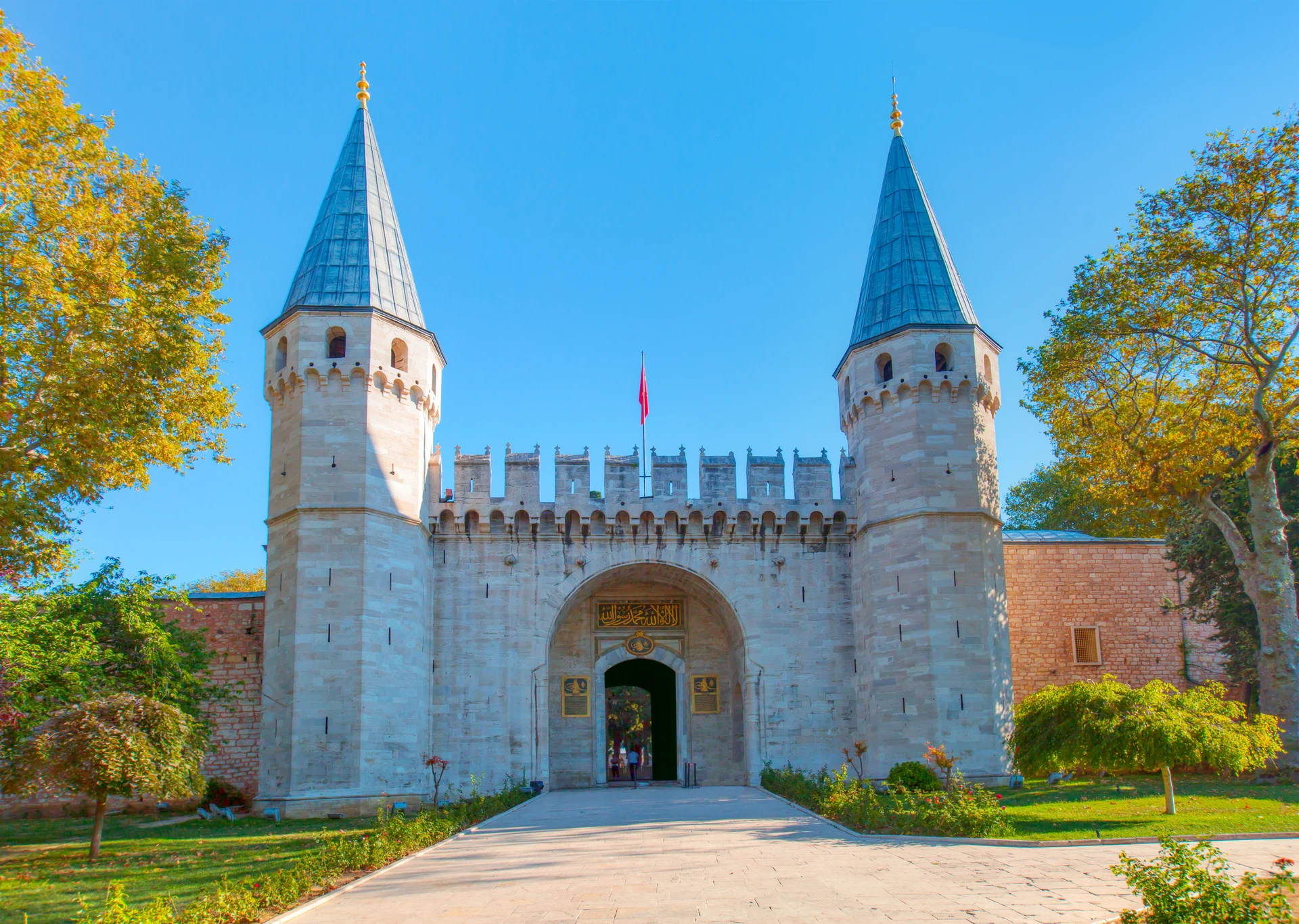
A palace best understood by walking through its gates
Topkapı Palace occupied the point of the historic peninsula where routes across the Bosphorus, the Golden Horn and the Sea of Marmara meet. Looking at it from the water, one sees roofs, trees, walls and pavilions extending along the ridge. There is no single façade behind which the whole palace can be imagined. Its rooms were distributed across a succession of courts, gardens and more secluded enclosures. To understand how the Ottoman court worked, follow the changes in the size and character of those spaces. A gate that looks modest may have marked a far more consequential boundary than an imposing wall visible from the sea.
Mehmed II established the palace after the Ottoman conquest of Constantinople in 1453. It developed over subsequent reigns as a residence, a seat of government and a place where members of the imperial household were educated and employed. Different rulers commissioned new buildings or remodelled existing ones, and fires and other events prompted major campaigns of reconstruction. This long history is visible in the variety of the architecture. One court may bring together a building recognisably different in date from its neighbour. Their relationship often makes better sense in terms of the work carried on inside them than as a single decorative composition.
The outer enclosure and the first court
The approach from the city passes through the Imperial Gate into the first court. This outermost zone accommodated a wide range of activities and provided access to the more closely guarded palace beyond. Hagia Irene, an early Byzantine church, stands within it. The survival of this building in the palace grounds gives physical substance to a fact easily lost in a chronological account. The Ottoman palace was built on a peninsula already densely marked by its earlier history. Incorporation, adaptation and construction on new ground all helped shape the layout.
The first court feels relatively open compared with the spaces farther inside. That difference is worth noticing before moving on. A great imperial household needed deliveries, guards, craftsmen and many people whose work did not entitle them to approach the ruler. A layered arrangement of access allowed the palace to receive people and goods without exposing its most restricted spaces. Someone whose business ended here knew the palace through a very different set of buildings from those familiar to a member of the inner household. Both experiences were authentic, although neither alone would explain the whole institution.
Passing between the towers
The Gate of Salutation, with its pair of towers, opens into the second court. It is one of the clearest visual landmarks on the palace route. Through it, a visitor moves into the area of administration and formal service. The pathways across the second court lead towards different functions rather than towards a single ceremonial staircase. The council buildings stand on one side, while the great kitchen complex occupies the other. In the distance the next gate marks the way into the inner court. The open space between these institutions made them part of the same establishment while keeping their work distinct.
Pause where several paths are visible at once. One can imagine the movement of an official attending council, a worker connected with the kitchens and a member of the household approaching the more private gate. They might cross the same court with quite different purposes and rights of access. Modern visitors tend to follow the sequence of museum displays, which can make one room seem as accessible as the next. The historic logic of the palace depended on differences in who could pass, at whose invitation and under what conditions. The shape of this court is a particularly good introduction to that principle.
The council and the Tower of Justice
The Imperial Council met in the Divan, where senior officials dealt with the affairs of the empire. The grand vizier played a central role in the council's work. The suite is associated with the administration of petitions, hearings and the circulation of decisions across a vast territory. These processes required clerks, records, messengers and carefully regulated communication as well as the presence of senior statesmen. Look at the relationship between the formal rooms and the courtyard outside. Decisions made in a comparatively small suite could have consequences far beyond the walls of Istanbul.
The Tower of Justice rises above this part of the palace and is visible from distant viewpoints. Its vertical profile contrasts strongly with the largely horizontal arrangement of courts and low buildings. In the council room a screened opening associated with the sultan's ability to hear proceedings gives architectural form to the relationship between sovereign and ministers. Presence could be felt even when the ruler did not take a public seat among them. Compare this with the nearby Hippodrome of Byzantine Constantinople, where the ruler's box made the emperor conspicuous to an enormous crowd. The two settings reveal different choices about when power should be visible.
Feeding an imperial household
Across the court, a long row of kitchen chimneys announces a very different kind of concentration of power. Maintaining the palace required regular supplies of grain, meat, fuel, water, utensils and countless other materials. There were meals for large groups as well as dishes prepared for members of the imperial family. Distinctions of rank affected the organisation of service. The number of people to feed varied with the occasion. A reception or a ceremonial distribution demanded coordination between those who stored ingredients, prepared food, carried it and cleared the vessels afterwards.
The kitchens are especially revealing when considered alongside the palace collections. Fine porcelain and other serving vessels had practical roles, signalled distinctions of status and could also be kept because of their beauty or rarity. A dish made far from Istanbul may record a commercial network or the movement of a diplomatic gift. A specialised cooking vessel tells a different story about heat, quantity and the physical demands of preparation. When an object is on display, look first at its dimensions. A great pot and a delicate dish can represent stages in the same meal, attended by people who occupied quite different positions within the household.
The Gate of Felicity and a changed relationship to the sovereign
The Gate of Felicity gives access to the third court, associated with the inner palace or Enderun. The gate was also a setting for major ceremonies. Its importance can be difficult to recognise today precisely because visitors may walk through it with relative ease. Standing on the approach and looking back across the second court helps restore some of the distinction. Behind lies the busy fabric of government and service. Beyond is a more selective environment closely attached to the person of the sultan. The boundary could be used ceremonially to bring those two worlds into carefully controlled contact.
The Audience Chamber stands just inside the third court. Its placement means that an ambassador or senior official could be admitted to the ruler's presence without proceeding into the deeper residential parts of the palace. A reception involved much more than the contents of a single room. The procession through the outer spaces, the wait, the crossing of a threshold and the designated position of each participant all contributed to the encounter. When you reach the chamber on a visit, think back to the sequence of gates just passed. Architecture has already done much of the work of preparing an audience before anyone speaks.
Education, service and collections in the inner court
The Enderun brought together rooms used for training and service, the treasury, the Privy Chamber and other parts of the sultan's household. Young men educated for service in the palace acquired skills required in its administration and ceremonial life. An imperial establishment also supported specialist makers and people responsible for the care of valuable objects. The palace therefore offers evidence for the transmission of knowledge as well as the exercise of authority. The survival of books, calligraphy, textiles and intricately worked objects makes more sense when considered beside the rooms and institutions that sustained such expertise.
When looking at a treasury display, choose an object whose method of manufacture you can begin to recognise. A jewelled surface may rely on a precisely shaped metal setting as much as on the value of the stones. A written page brings together paper preparation, an understanding of proportion, ink, pen and sometimes illumination and binding. Precious materials could reach the palace through trade, tribute, gifts or commission. The label may identify one of those histories. It is more rewarding to pursue a documented connection for one object than to assume that every costly piece reached Istanbul by the same route.
Sacred objects and the space around them
Rooms associated with the Privy Chamber preserve Islamic sacred relics. Their significance for visitors can differ considerably from that of a treasury object admired chiefly for design or workmanship. For some, the encounter is devotional. Others come to understand how Ottoman rulers expressed guardianship and religious legitimacy through the custody of treasured objects. The two approaches can share the same physical space. Conduct that allows people time and quiet around a display matters here just as much as a correct identification of an object.
A further distinction is useful when interpreting palace collections. A room can have a historic purpose of its own and a present use as a setting for objects collected from several places or periods. The existence of an object in a display does not necessarily establish that it was used at precisely that spot. Ask what is known about the room, the object and the history of the display separately. A visit to Topkapı repeatedly rewards this habit because the modern museum occupies a palace in which rooms were already reassigned, repaired and redecorated during the centuries of imperial occupation.
The Harem as a household
The Harem contained the private apartments of the dynasty and the accommodation of many of the people who served it. It developed in stages and is made up of passages, courtyards, rooms and suites arranged with close attention to rank and privacy. The queen mother, known as the valide sultan, could exercise substantial influence within the household. Princes and other members of the imperial family lived and were educated in settings shaped by dynastic circumstances. Eunuchs and other members of the household administered access and services. The institution also depended on slavery, a reality that decorative beauty alone cannot convey.
Notice how the transitions work. A narrow passage may open into a small court, which in turn provides indirect access to a more elaborately finished suite. A door positioned to limit a direct line of sight can preserve privacy more efficiently than a great distance. Tiled surfaces and painted ceilings can establish hierarchy through the concentration of skilled work. Some rooms offered views, others were internal and closely controlled. Taken together they make a much more complex picture of residential life than the familiar idea of a single luxurious royal apartment. Check the arrangements for the Harem separately when planning a visit, particularly if it is central to your interest in the palace.
Pavilions above the water
Farther into the grounds, a series of terraces and pavilions opens views towards the surrounding water. The Revan and Baghdad pavilions belong to the seventeenth-century court of Murad IV and commemorate campaigns in the east. Their interiors combine materials and techniques at a scale quite different from the council suite or the monumental kitchens. A pavilion was a place for a particular occasion, season, view or gathering. Its plan can be understood in relation to the people seated within it and the direction in which doors and windows opened onto the garden.
The water is part of the history of the palace as well as a pleasing background. From these heights a court based on the peninsula could look towards the approaches to the Golden Horn, the Asian shore and the movement of vessels between districts. On a clear day the view can seem almost like a chart of Istanbul, although what is visible depends on your precise position. Choose one shore and follow it across the horizon. Then turn back towards the layered gardens and roofs. The palace drew part of its character from being simultaneously enclosed behind walls and open to such distant views.
A palace of different working distances
When the Ottoman court shifted its principal residence to palaces on the Bosphorus in the nineteenth century, Topkapı retained important collections and memories of earlier government. Its life as a museum added another way of using the courts. A traveller can now pass between settings historically reserved for quite different groups. The opportunity is especially valuable when it is used to notice those differences. A gate between two courts, a chimney above a roof and a screen in a council chamber each explain something a splendid jewel alone could never tell.
For a short visit, pick one relationship to carry through the route. It could be the movement of food from the kitchens to an intimate dining setting, the movement of an ambassador towards the Audience Chamber, or the passage from a public ceremony to a secluded garden. This makes a more coherent memory than a rapid series of unrelated cases. Topkapı was large because an empire required many kinds of work. The pleasure of walking through it is discovering where those activities met, where they were deliberately separated, and how much the simple act of crossing a threshold could once mean.