
Şirince Village
Walk between hillside houses above Selçuk and notice how one street looks across the roofs of the next. Vineyards, orchards and village trade connect the settlement to its surrounding land. Its former Greek Orthodox churches recall the community that lived here before the population exchange.
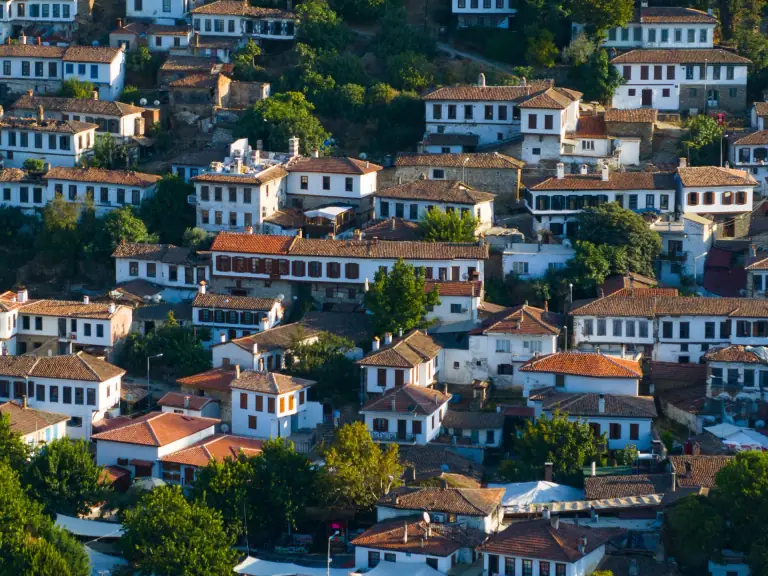
A village seen across its own rooftops
The road east from Selçuk changes the scale of a day around Ephesus. The plain opens behind and cultivated hills draw closer. In Şirince, houses sit at different heights along the slopes, so a walk that begins beside a door may soon offer a nearly level view across the roof below it. From some positions, tiled roofs overlap in long rows. From others, a gap between buildings frames a garden or a patch of hillside. The village makes sense when seen from several of these positions. Its shape belongs as much to the slope and the cultivated land as to any individual house.
Şirince is a living settlement in the district of Selçuk, in İzmir province. People come for the architecture, the food and drink sold in its shops, the village's former Orthodox churches and the opportunity to walk somewhere very different from the monumental streets of ancient Ephesus. Those interests fit together. A stone lower storey may recall the need for storage. A vineyard supplies a product that can be consumed locally or sold to visitors. A church terrace offers a view of the village once served by its congregation. Each is part of a history in which homes, religious communities and agricultural work were closely connected.
How a hillside makes a street
Spend a few minutes following a lane across the slope before taking one that climbs. The first may curve to keep a fairly constant level. The second often changes character over a very short distance as the gradient steepens. A bend can protect the approach to a doorway, work around a garden wall or bring a lane into line with an older boundary. These adjustments help explain why a map of the village looks irregular from above. A person carrying a basket or leading an animal experienced these routes in terms of effort, footing and access to a particular property.
The relationship between a street and a house also changes with height. A building reached directly from a lane on its uphill side can appear a storey taller from below. A wall that looks disproportionately high from a narrow passage may be retaining a garden as well as enclosing it. Notice how often a boundary does two jobs. A few steps can make a threshold level, direct rainwater away from an entrance and separate the public lane from the domestic interior. An eye for these practical relationships gives the walk more depth than simply collecting photographs of white walls and red roofs.
Old houses and the materials people had to hand
Many traditional houses in Şirince combine a substantial lower part with a more lightly built upper storey. Stone, timber, plaster and clay roof tiles contribute different qualities. Stone provides mass and suits the base of a building on uneven ground. Timber makes it possible to frame openings, span rooms and sometimes extend an upper part slightly beyond the line below. Pale plaster can unify a surface assembled from several materials. The appearance of a traditional house depends on the way these elements work together, rather than on a single decorative feature repeated throughout the village.
Look at a house from the opposite side of a public lane where the width permits. Start at the roof and follow the route rain would take. Projecting eaves protect the wall beneath, while roof pitch and the overlap of tiles direct water away. Then consider how the upper rooms receive air and light. A row of windows can make a living space brighter than the lower level used for work or storage. A shutter offers privacy and shade without changing the size of the opening. Individual buildings have been altered, so these are questions to test against what you actually see. The variation is part of the interest.
A restored guesthouse and an occupied family house can look similar from a distance yet have different requirements inside. Plumbing, heating, kitchens and modern standards of comfort all need to fit into an older structure. A carefully repaired wall may contain new materials alongside old ones. Asking which parts have been repaired, and why, is often more useful than asking whether a building is completely original. A village in which people continue to live has always undergone maintenance. The challenge is keeping the relationship between buildings, gardens and public streets intelligible as the uses of individual properties change.
A community shaped by the population exchange
Before the upheavals of the early twentieth century, Şirince was home to a Greek Orthodox community. Older names for the settlement survive in historical accounts and family memories in more than one language. The compulsory population exchange agreed between Greece and Türkiye in 1923 brought a profound change in the people living here. Orthodox families departed, and Muslim families displaced from Greece settled in the village. The homes, gardens and churches acquired new relationships to the people around them. Familiar buildings could remain standing through circumstances that broke the continuity of an entire household's life.
For a visitor, the exchange can sound like a single administrative event. At the scale of a family it involved leaving property, graves, neighbours, patterns of work and the local knowledge needed to make a living. New arrivals might understand farming or trade very well while facing unfamiliar land, crops or arrangements of a house. Buildings record some of these changes, but cannot explain them all. Oral histories and family records supply kinds of evidence that the streets alone do not preserve. It is worth taking particular care with claims that one custom, dish or architectural feature belongs exclusively to one population.
One thoughtful way to approach this history is to separate three questions. Who built or used a place in a particular period? What happened to it during the change of population? What does it mean to the people who live around it now? The answers may be very different without contradicting each other. A church can carry the memory of worship for descendants of a former congregation and be part of the local cultural inheritance for neighbours today. An orchard can preserve an older pattern of cultivation while providing an income for a family with a different history of migration.
Two churches and their place in the village
The churches associated with Saint John the Baptist and Saint Demetrius are important surviving witnesses to the former Orthodox community. The Church of Saint John the Baptist occupies an elevated terrace. Its setting offers a useful lesson in the difference between a village church and the monumental ruins on many Ephesus itineraries. The church belonged to people living in the surrounding streets. Distances between front doors, the approach to the terrace and the shared space outside a place of worship were ordinary features of community life. The settlement itself is part of the context needed to understand the building.
The dedication to John the Baptist can cause confusion on a day visiting several Christian sites. The great Basilica of Saint John on Ayasuluk Hill in Selçuk is associated with John the Apostle. The Church of Mary in the ancient city and the House of the Virgin Mary on a different mountain are separate places again. Keeping their names and locations distinct does more than tidy up a map. It distinguishes the Byzantine pilgrimage landscape around ancient Ephesus from the much later life of an Orthodox village in the hills. A guide can explain the connections in regional religious history while keeping those differences clear.
At Saint Demetrius, notice how a village-scale building forms a landmark among much smaller domestic roofs. The immediate setting can be as instructive as the interior. A widening in a lane, a wall around a terrace or a view from the approach marks the transition between everyday movement and a communal destination. Access can vary, and some routes adjoin private premises. Looking from a public path can still reveal the relationship between a church and the settlement. A locked door does little to diminish the value of locating these buildings in the landscape of the former community.
Orchards, olives and the village economy
From an opening between the houses, look beyond the first row of trees. The cultivated slopes make clear why a village famous for tourism also needs to be understood as a farming landscape. Fruit trees, olives and vines demand different kinds of work at different times of year. Pruning, harvest, storage, processing and transport shape the use of household space and link the village to markets lower down. A road that visitors experience as a scenic approach is also the route by which produce, supplies and workers move between settlement and plain.
The peach is among the fruits associated with Şirince. In season, the difference between a fruit sold fresh and one preserved or turned into another product is partly a matter of timing. A harvest arrives over a limited period while demand and opportunities for transport do not always coincide with it. Processing allows part of the crop to travel farther or be enjoyed later. An olive, a bottle of oil and a bar of olive-oil soap also represent different decisions about preparation, storage and sale. Looking at products in that order gives a small village shop its place in a much wider history of rural resourcefulness.
The village is well known for shops offering fruit wines alongside grape wines. These are different products with different ingredient lists, sweetness and methods of production. If something interests you, ask what fruit it contains, who produced it and where it was made. The most satisfying discovery may be a simple explanation of the difference between two bottles rather than the largest possible tasting. Visitors who do not drink alcohol can follow the same agricultural story through fresh fruit, preserves, bread, olives or oil. What is available in a particular shop or season should shape that choice.
What a viewpoint can teach about conservation
Seek out a public point from which roofs, trees and houses can be seen together. The distinctive impression comes partly from repeated materials but also from spacing. Gardens break up the built surfaces. Rooflines step with the slope. Narrow streets leave room for comparatively little traffic in the older parts. A single very large building or a terrace that removed too much vegetation could alter the view from many positions at once. Protecting the appearance of Şirince therefore involves decisions about the relationship between properties as well as the repair of individual façades.
This connection matters for a settlement that earns income from its historic character. Businesses can help keep old buildings occupied and pay for repairs. At the same time, delivery needs, visitor numbers and conversion to commercial use can put pressure on spaces designed around domestic life. The village's recognition in the Best Tourism Villages initiative brought wider attention to the relationship between tourism and rural livelihoods. The most informative question to ask on the ground is how a particular enterprise works with its surroundings. A shop selling identifiable regional produce tells a different economic story from a display of goods with no connection to the area.
Taking the village at walking pace
A comfortable route usually combines a section of the main commercial lanes with a quieter public street and a view towards the cultivated hills. Climbing every available lane is unnecessary to understand the village. The uneven paving and gradients matter if a member of the group prefers a shorter or more level route. Discuss that preference before setting off uphill, since a short distance on a plan can involve a noticeable climb. Leave enough time to come down at an unhurried pace, especially where people, deliveries and visitors share the same narrow lane.
This stop pairs naturally with ancient Ephesus because the two places pose different questions about settlement. At Ephesus, excavation reveals how streets, public buildings and private houses once worked in a city whose harbour landscape changed over time. In Şirince, the houses remain in use and the relationship between living rooms, public paths and productive land is visible on a much smaller scale. A church terrace, the roof of a neighbour's house and an orchard can occupy a single view. The pleasure of the stop lies in understanding how those elements came to share the same hillside, and in remembering that for the people who maintain them this is home.