
Ephesus Ancient City
Follow the slope from the civic quarter towards the Library of Celsus and the Great Theatre. The road beyond the theatre once led to a harbour. Its distance from the sea today helps explain how silting reshaped the city.
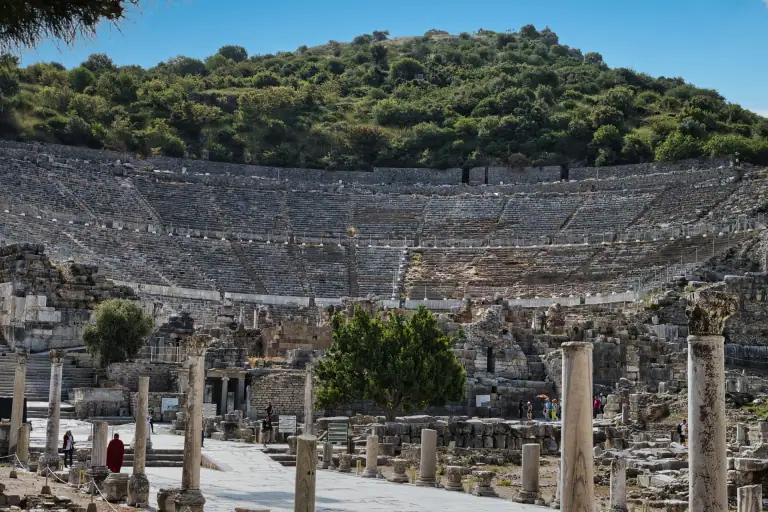
The city at the end of a road to the sea
Stand near the Great Theatre and look along the broad avenue running away from its foot. The destination is the surprising part. No sea is visible at the end of the road today, yet this was an approach to a harbour. People once arrived from ships and made their way inland along streets that now seem very far from the water. That one observation helps make sense of ancient Ephesus. A city famous for the beauty of its marble buildings depended on something much less stable than stone: an accessible connection between the Aegean and the land routes of western Anatolia.
The Ephesus you can walk through is a large excavated part of a much larger settlement. Its monuments do not represent a single moment in time. A Hellenistic plan, Roman imperial façades, late antique repairs and the marks of modern reconstruction can occur within a short distance of one another. A walk becomes easier to follow if you choose two questions at the beginning. Where would this street have taken someone, and who would have had a reason to use it? A local official, an arriving merchant and a person going home could pass the same grand building on quite different journeys.
A region with several centres
The name Ephesus belongs to a history that extends beyond the ticketed archaeological site. The sanctuary of Artemis lay on the plain closer to modern Selçuk. The monumental streets commonly visited today occupy ground between hills, while the later focus of settlement and Christian pilgrimage developed around Ayasuluk Hill. Putting those places on a map prevents a common misunderstanding. The Temple of Artemis did not stand between the Celsus Library and the theatre, and the Basilica of Saint John was never an adjoining room of the Church of Mary. Their relationships made sense at the scale of a region.
The moving shoreline is part of the explanation. Rivers draining the interior carried sediment towards the coast. Over time deposits changed the shape of water channels and the relationship between land and sea. A harbour needed continuing attention if it was to remain useful. It is tempting to turn this into a simple story in which a city thrived, its port silted up and everyone left at once. The archaeology suggests a longer process in which centres of activity shifted and communities continued adapting to altered conditions. The distance to the sea is the beginning of the story, not its entire explanation.
The upper city and its public business
The upper civic quarter offers a useful starting point even for someone chiefly interested in the famous buildings further downhill. An open square and the structures around it provided settings for public business. Nearby stood a covered council or assembly building conventionally called the bouleuterion or odeion. Its rows of seats resemble a small theatre, but the resemblance need not imply an identical programme of events. An enclosed space with a clearly focused audience could serve a city in ways very different from a vast open-air venue associated with public spectacles.
Try reading this area in terms of access. A person crossing a square could encounter activities taking place around its edges without necessarily being entitled to participate in all of them. At a council meeting, who sat where and who had the right to speak would have mattered. Many encounters at a busy civic centre, meanwhile, took place outside the formal meeting room. The ruins retain the relationship between the open ground, the entrances and the seating more readily than they retain the sound or the rules of an actual meeting. A guide can help separate what is visible from what comes from inscriptions and comparisons with other cities.
Down Curetes Street
A visitor moving down Curetes Street encounters a city that put a great deal of effort into the appearance of its public routes. Pedestals, fountains, façades and honorific texts turned the journey itself into an occasion for looking. A statue standing high above the paving did more than fill a gap. It placed an individual or a benefactor in the public eye of people who passed repeatedly. A written dedication could specify who had paid for a structure or whose memory was to be honoured. Even where the figure and the inscription have become separated, the position of a base can say something about its audience.
The most revealing comparison may be between what happens at eye level and what happens underfoot. From a distance, marble paving can resemble a smooth, uniform surface. Close up, its joints, worn parts and repairs reveal a street that had to be kept in use. A change in width or level affects the way people move past an entrance. Try walking a short distance, then looking back in the opposite direction. A façade that dominates a downhill view may be barely noticed on the return. The builders of cities worked with these differences, and an itinerary that follows only a list of monuments can miss them.
The Library of Celsus, from across the square
The library façade is one of the easiest buildings in Ephesus to recognise and one of the easiest to hurry past after taking a photograph. First look at how its columns, niches and openings fit into the space at the bottom of the street. The squares of light and shade change with the movement of the sun. The projecting elements encourage the eye to travel sideways and upwards, giving a relatively narrow frontage a remarkable presence. Then look at the neighbouring gateways. A grand library stood beside routes used by people with commercial business as well as by those with literary interests.
The library also served as a memorial to Celsus, a Roman public figure whose burial was associated with the building. The combination of a place for written learning with an enduring family commemoration makes the façade more intelligible. It was an institution, a gift and a statement about a person at the same time. Its present appearance owes much to the work of archaeology and reconstruction. The front standing in the square is not evidence that an entire ancient library remained untouched for nearly two thousand years. The reassembled pieces allow you to appreciate its design while asking what is known about the much less complete interior.
Goods, people and the commercial agora
Beside the library lies the commercial agora. The term agora denotes a public space for exchange or assembly, and in this setting the network of surrounding rooms and entrances helps explain its commercial character. Imagine arriving with goods that had come through the harbour. A market needed ways to bring things in, room for people to inspect or negotiate over them, and connections to the rest of the urban fabric. A single decorated gate attracts attention, but the useful thing to follow is a possible sequence from street to entrance to covered edge to open square.
The scale of the square tells a different story from an individual find. The ground plan gives room to imagine many transactions taking place close together. A coin or a stamped object, when discovered in a recorded context, can supply a different kind of evidence about money, production or movement. Neither alone provides a full picture of an ancient shopping day. A coin might have circulated long after it was struck, and an empty room does not identify the precise commodity once sold there. If your itinerary also includes the archaeological museum in Selçuk, a labelled object can supply just the kind of close evidence that the walk cannot.
A public theatre and its audience
Seen from the road below, the Great Theatre belongs to the hillside. Seen from higher up, it opens out towards the former harbour district. Those two views help explain both the engineering of a great place of assembly and its public presence. Tiers of seating directed a large audience towards a common focus. Access routes had to bring people to different levels and let them disperse afterwards. A performance lasted for part of a day, but the movements of a large crowd before and after it were events in the life of the surrounding streets.
The theatre is also connected with the story of early Christianity through the disturbance described in Acts of the Apostles. In that narrative the cult of Artemis, the interests of craftsmen and anxiety about new religious teaching all play a part. The text describes people gathering in the theatre; it does not provide a reason to point to a particular surviving stone as the spot on which Paul preached. The distinction makes the account more interesting. A civic gathering place could give physical form to a dispute involving work, worship and the reputation of the city itself. Here a written narrative and a surviving public building offer different ways into the same question.
Houses behind a city of monuments
From the grand public route it is a short distance to the residential complex known as the Terrace Houses. Its position matters even if the interiors are outside the programme of a particular visit. Affluent households lived close to the route along which a city displayed its public honours. Within their walls the important spaces were on a very different scale: an opening towards a court, a decorated dining or reception room, a stair leading to another level. Those settings called for skilled work in plaster, mosaic, stone and water installations.
The existence of prosperous houses should not be taken as a portrait of every resident. The people who occupied them, the people who supplied them and the people whose work kept them comfortable did not necessarily experience the same city. An expensive wall surface records choices about what visitors to a room should see. It rarely names the people who cleaned it, carried materials to it or repaired the structure behind it. A good way to bring everyday life into a monumental city walk is to choose one finished surface and work backwards through the chain of effort needed to produce and maintain it.
A city that continued changing
Ancient Ephesus did not stop changing when its most familiar Roman façades were complete. Buildings were adapted, spaces subdivided, materials reused and religious communities made new claims on the urban landscape. In the former harbour district the Church of Mary offers an especially clear example of a Christian institution taking shape within an existing built environment. The Council of Ephesus in 431 gives the city a prominent place in the history of Christian debate. The lives of residents in the surrounding quarters continued through periods of damage, rebuilding and eventual changes in settlement.
The most spectacular monument is not necessarily the best evidence for the last people to use an area. A blocked doorway can indicate that one route ceased to be convenient. A small structure built inside a once grand space can record a new purpose for old walls. It would be easy to dismiss such changes as damage to an earlier design. For the people who made them, they were practical choices in a place that still mattered. Looking for one of these later adaptations can change a visit from a search for the city's moment of greatest wealth into a much fuller account of its history.
Reading the site at walking speed
For a first visit, choose a small number of places at which to stop moving entirely. The upper public buildings, a point on Curetes Street, the library square and the theatre provide different settings for the same exercise. Observe a line of movement, identify a place where someone could stand or sit, and find a surface that was clearly designed to be seen. At the next stop, repeat the exercise. An audience assembled in seats, people moving across a market and guests arriving at a house organised their attention in different ways. Those differences tell you more about an urban society than a handful of isolated dimensions.
Before leaving, return mentally to the avenue beyond the Great Theatre. Its destination gives the monuments a geographical setting and connects the day’s walk to journeys made by other people. Ships brought more than goods. They brought languages, habits of worship, building techniques, family contacts and political news. Routes inland carried them further. The city left behind by those exchanges can still be explored with the simplest of questions: from this point, where could someone go next? Once you can answer that for a few streets, Ephesus begins to feel like a place in which people had business, neighbours and destinations, rather than a collection of separate ancient sights.
Tours
- Ephesus Istanbul Shore Excursions
- Ephesus Private Full Day Tour
- Ephesus Shore Excursion
- Private Ephesus Day Tour
- Private Ephesus Sirince Village Tour
- Private Ephesus Tour from Kusadasi Port
- Private Ephesus Tour with Terrace Houses
- Private Guided Ephesus Tour
- Private Half Day Ephesus Tour
- Private Tour of Ephesus from Kusadasi Port
- Tour of Ephesus Museum Virgin Mary House
- Private Ephesus Archaeology Tour