
House of the Virgin Mary
A small stone sanctuary on Mount Koressos is a place of Christian pilgrimage. Its association with Mary belongs to religious tradition. The quiet chapel and the wooded approach offer a different experience from the excavated churches in the ancient city.
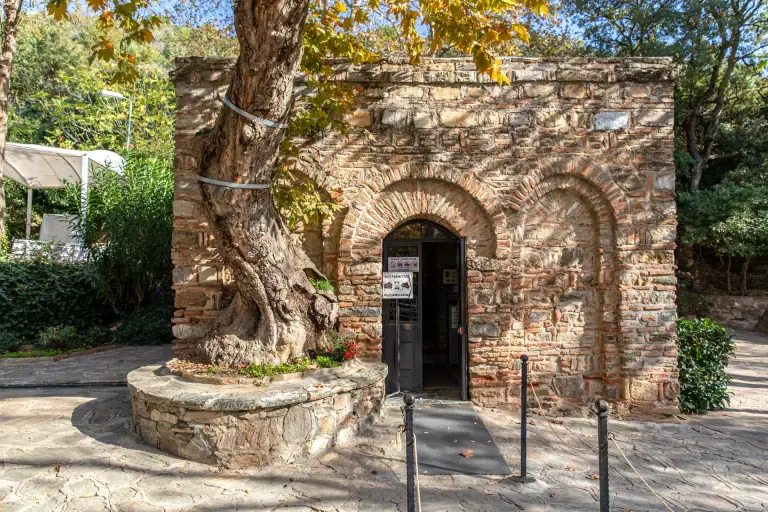
A small sanctuary above an ancient city
On a map of Ephesus, the House of the Virgin Mary belongs to a different landscape from the theatre and the library. The ancient city's public buildings occupy a valley that once opened towards the sea. The sanctuary known in Turkish as Meryem Ana Evi stands in wooded country above it, on Bülbül Dağı. The journey uphill separates two kinds of visit. In the streets below, people follow the outline of an ancient city. On the mountain they approach a small, living place of devotion. An understanding of Ephesus helps to explain the tradition that brings pilgrims here, but the atmosphere at the door of the chapel asks for a different pace.
The building is modest enough that a person arriving with the word “shrine” in mind might wonder whether there is more to see further on. Its importance has little to do with the size of its interior. For believers who associate the place with Mary, its domestic scale is central to its meaning. For visitors interested in history, the more interesting question is how a particular spot came to carry that association and how it continues to be recognised. These questions can be explored together without making agreement about the tradition a condition of appreciating the visit.
What the name of the house means
The name refers to a Christian tradition according to which Mary, the mother of Jesus, lived in the region of Ephesus towards the end of her life. The story is often told together with the tradition of Saint John at Ephesus. The Gospel of John describes Jesus entrusting his mother and the disciple whom he loved to one another. Readers have connected this passage with later Christian memories of John in Asia Minor. The passage itself supplies no address in the hills above Ephesus. It explains why the two figures became linked in Christian imagination without settling the question of where Mary lived.
Visitors sometimes encounter a second tradition that places the end of Mary's earthly life in Jerusalem. These memories grew in different Christian settings over a long period. A guide can explain why the Ephesian tradition matters to people who come here while acknowledging that the surviving sources do not resolve the question as a modern biography might. This distinction also helps explain why two visitors can experience a powerful sense of place for different reasons. One may be reconnecting with a story heard in childhood. Another may be thinking about how communities make a distant religious past present through worship, travel and shared memory.
How the place came to wider attention
The modern history of the shrine includes a striking encounter between a European devotional account and a search in western Anatolia. The German religious visionary Anne Catherine Emmerich described scenes associated with Mary's life. Accounts attributed to her circulated after her death. In the nineteenth century readers tried to relate the described landscape to a real place near Ephesus. A search by Lazarist clergy from İzmir in 1891 is an important episode in the modern recognition of the sanctuary. Remains on the wooded mountain became the focus of investigation and renewed pilgrimage.
This history contains several different kinds of evidence. A printed account tells us about ideas in circulation among its readers. The search tells us what a particular group was looking for and where it looked. The surviving masonry and its setting raise questions that architectural study can investigate. The fact that people came to pray at the place is evidence for its devotional history. Each can be discussed on its own terms. If the different strands are merged into a single assertion that a house was identified in the same way as a building named in an ancient inscription, the most unusual part of the story is lost.
Looking at a building that has been cared for
The house seen on a visit incorporates restoration and the work of people who have continued to use the site. It is a small stone chapel. Features such as the entrance, the transition into the central space and the focus towards the altar make it legible as a place of worship. A visitor interested in domestic architecture may be surprised by that character. The name preserves a tradition about a home, while the arrangement visible today records a history of religious use. Looking for the furniture or room plan of a first-century dwelling would ask the present building a question it cannot answer.
Outside, the change of light from the approach to the dark opening of the doorway makes even a short walk feel like a transition. Inside, the turn of the walls and the restricted floor space bring the focus close. These observations are available to anyone, regardless of belief. They also explain something practical about the visit. In a small chapel, a person who stops in the middle of an entrance can affect everyone behind. A useful place for a group explanation is often outside, before entering. That leaves each person free to move through the interior with attention to the people already there.
Mary in more than one religious tradition
Mary is important in Christianity in ways that vary among Christian communities. Visitors may know her through accounts of the life of Jesus, through the dedication of churches, through prayers, or through feasts and images encountered throughout the year. In Islam, Maryam is also a revered figure. The Qur'an gives her a prominent place, and people from Muslim as well as Christian backgrounds visit the shrine. Shared attention to Mary does not mean that Christian and Muslim understandings of her are identical. The common ground lies in the fact that this place is meaningful to people who bring different traditions with them.
That variety is often more apparent in the manner of a visit than in anything said aloud. Some people come in family groups, others spend time in personal prayer, and others are interested chiefly in history. A moment of silence can make space for all of those intentions. A visitor does not need to perform a gesture of devotion in order to be respectful. Equally, a person who wishes to pray may value a little time apart from the historical explanation. A private group can agree on a meeting point before entering so that different interests do not become competing demands at the chapel door.
Pilgrimage and the ordinary acts of a visit
Pilgrimage can give a journey meaning well before arrival. Someone may have carried a family request from another country or planned a visit around a feast. A traveller joining a wider tour may not know the site's history until the day itself. Both arrive along the same approach and encounter the same small building, but the time they need can be quite different. The objects visible near a shrine make more sense when seen against this range of purposes. Candles and written intentions are traces of acts performed by individuals, not a display arranged to interpret a historical period.
One recognisable feature of the site is the area where visitors have left written wishes or prayers. It can be tempting to inspect individual notes as if they were captions in an exhibition. Their real context is personal. From a little distance, the accumulation says more about the character of the place than a close reading of someone else's message. It also makes visible something the chapel alone cannot show: the sanctuary continues to acquire meaning through repeated visits. A person who comes to understand contemporary religious life can learn as much from that continuing use as from the age of a stone wall.
The springs and the wooded setting
Water is part of many visitors' experience here. The springs and water points along the route are associated with hopes, prayers and the customs of pilgrimage. The historical subject is the meaning assigned to the water by those who come. This is distinct from a claim about its physical effects. A guide can describe the custom and leave each visitor free to decide whether to take part. Even a brief pause along this part of the route gives a sense of how movement through the site continues beyond the interior of the chapel.
The wooded slope also affects how the sanctuary is remembered. At the ancient city below, long sightlines and large buildings compete for attention. On the mountain, trees break the view and the sound of the group may be more noticeable than anything in the distance. A photograph taken only from the threshold can give the misleading impression that the chapel is an isolated exhibit. If photographs are permitted on the approach, an exterior view that includes the path and a little of the surrounding vegetation records more of what gives the place its character. Observe any local instructions, especially in the interior and during worship.
Three places on a Christian heritage itinerary
The House of the Virgin Mary, the Church of Mary and the Basilica of Saint John are three separate stops in the Ephesus region. The House is the mountain shrine associated with the tradition of Mary's residence. The Church of Mary lies in the ancient city's harbour quarter and belongs to the history of the Christian community at Ephesus and the council held there in 431. The Basilica of Saint John stands on Ayasuluk Hill in Selçuk, where a major Byzantine church developed around the tomb traditionally identified with John. The three places have different buildings, histories and settings.
A useful way to distinguish them is to ask what brought people together at each. A council drew participants into debate about doctrine and authority. A great basilica organised movement around an honoured burial place. The pilgrimage to a sanctuary associated with Mary's home focuses attention on the memory of a life. None of these purposes excludes the others in the larger history of Ephesus, but they lead to different kinds of architecture and different habits of visiting. Knowing which sites belong to your particular programme avoids disappointment and makes the connection between them more precise when more than one is included.
Visits by popes and the public life of the shrine
Modern papal visits brought the sanctuary to the attention of many people far beyond Türkiye. Paul VI visited in 1967, John Paul II in 1979 and Benedict XVI in 2006. These journeys are important events in the modern religious history of the site. They help explain why a chapel of modest dimensions appears in the recollections of people around the world. A papal visit is evidence of the importance attached to a place for prayer and pilgrimage. It answers a different question from an archaeological investigation into when a particular wall was built.
The same distinction is valuable when considering photographs of large gatherings and the quiet conditions a visitor may find on another day. Photographs of a celebration record one way the site functions at a particular moment. They cannot convey the whole annual pattern of use. Conversely, seeing only a few people at the chapel does not mean that its importance is small. A shrine can have an international following and still be experienced as an intimate place. It is precisely the contrast between those dimensions that many travellers remember after leaving the mountain.
Making room for a visit that means something
Before the group walks up to the chapel, consider which question most interests you. It might be how the modern pilgrimage began, how the mountain relates geographically to Ephesus, how the sanctuary is used today, or where the tradition about John enters the account. Sharing one of those interests gives a guide a better starting point than a request for every possible date. Visitors who would like a moment for prayer can mention that wish before the group enters. Those who prefer to stay outside can still appreciate the scale of the building and the arrangement of the approach.
Afterwards, record one observation and one question as separate things. The observation may be a change in sound at the entrance, the short distance from the door to the focus of worship, or the way people gather outside while others move quietly through the chapel. The question might concern the building's earlier phases or the journeys that first drew modern attention to the site. Keeping those two notes apart respects both the place that can be experienced today and the historical problems that remain open. It is a particularly fitting way to remember a shrine whose importance has always depended on the meeting of landscape, testimony and belief.
Tours
- Ephesus Istanbul Shore Excursions
- Ephesus Private Biblical Tour
- Ephesus Private Full Day Tour
- Ephesus Shore Excursion
- Private Ephesus Day Tour
- Private Ephesus Sirince Village Tour
- Private Ephesus Tour from Kusadasi Port
- Private Guided Ephesus Tour
- Private Tour of Ephesus from Kusadasi Port
- Tour of Ephesus Museum Virgin Mary House